Google Ads policy and help pages were checked as of November 2, 2026 and change often.
Search "therapist near me" in most cities and the first results are often ads. Some belong to directories, some to large telehealth companies, and some to the group practice down the street. It is natural to wonder whether you should be there too.
Sometimes the answer is yes. Google Ads can fill an open caseload quickly when the setup is right. But mental health ads carry policy restrictions most other businesses never face, and a poorly built campaign can spend a month's budget on clicks from people who were never going to book. This guide covers when ads make sense, the rules that apply to mental health, and a simple way to tell whether they are working.
Key takeaways
Key takeaways
- Ads fit when you have open spots now, a searchable niche, a site that converts and same-day replies.
- Health is a sensitive category. Plan on no remarketing, customer match or lookalike audiences.
- Addiction services need certification, and some telemedicine and prescribing ads do too.
- Send every click to a matching specialty page, and add negative keywords on day one.
- Your website is half the campaign. Smart Psych Websites builds specialty-first sites from $99 a month, with the setup fee waived when you sign up within 72 hours of viewing your free preview (never charged on yearly plans).
How Google Ads work, briefly
You choose search terms (keywords) you want to appear for, write ads, and set a budget. When someone searches a matching term, Google runs an auction. You pay when someone clicks. Your position and price depend partly on your bid and partly on ad quality. Google's Quality Score reflects expected click-through rate, ad relevance and landing page experience (Google Ads Help: About Quality Score, as of Nov 2026).
That last factor matters: a clear, relevant landing page can help your ads show more often for less. Your website is part of your ad campaign whether you think of it that way or not.
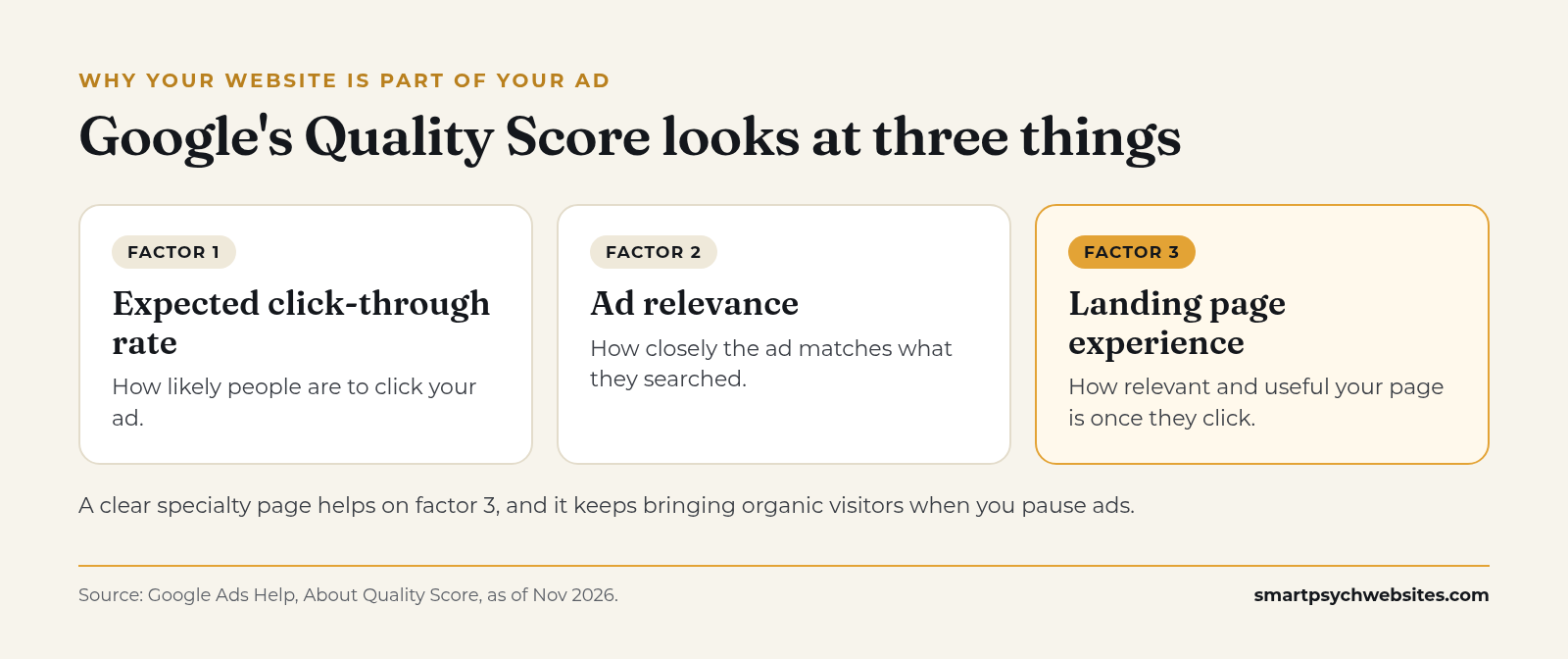 Your landing page is one of the three. That part is your website.
When Google Ads make sense for a practice
Good fits:
- You have open spots now and need inquiries this month, not in six months.
- You are launching something new: a new location, a new clinician in a group, a new service like an intensive outpatient program or interventional psychiatry.
- You serve a specific, searchable niche where people search with clear intent, such as "EMDR therapist [city]" or "couples therapist [city]."
- Your website converts. Visitors who land on your site can quickly see what you do, your fees or insurance, and how to reach you.
- You can answer inquiries fast. Paying for a click and then replying three days later wastes the money. See Therapy Client Onboarding.
Weaker fits:
- Your caseload is full or close to it.
- Your budget is small enough that you would only get a handful of clicks a month.
- Your website is slow, unclear, or not built for mobile.
- You have not set up a Google Business Profile or basic local SEO yet. Those are free and often worth doing first. See Local SEO for Therapists.
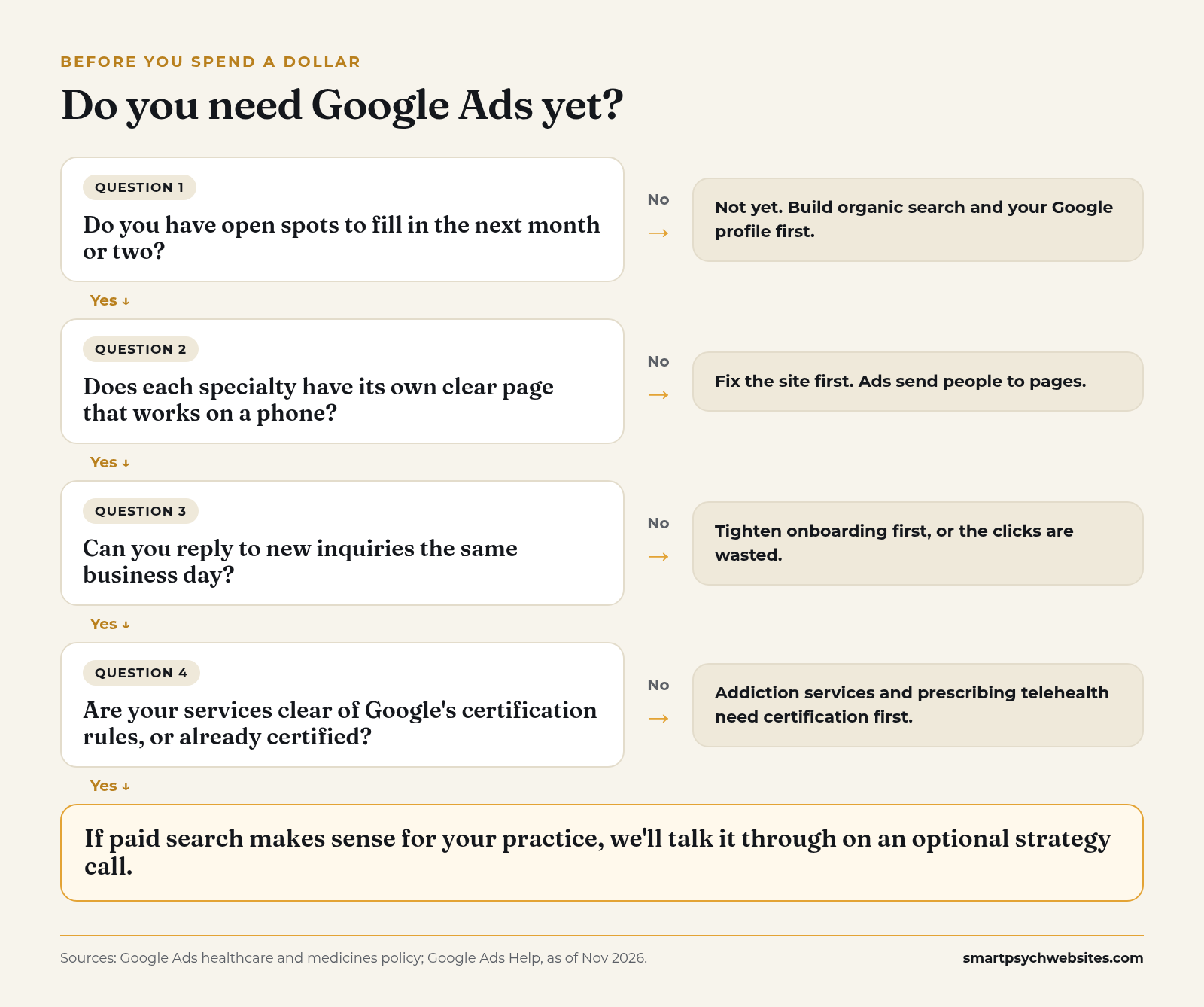 If any answer is no, fix that first. It costs less than clicks.
Google's rules for mental health ads
This is where therapy ads differ from, say, a plumber's. Google's policies change, so read the current pages before launching, and treat this section as a starting point rather than the final word.
Health is a sensitive category for audience targeting
Google's personalized advertising policy lists health as a sensitive interest category. Ads in sensitive categories cannot use advertiser-curated audiences such as your data segments (formerly remarketing), customer match, lookalike segments and audience expansion. Predefined Google audiences, such as in-market, affinity, demographic and location targeting, may still be available (Google Ads Help: Personalized advertising, as of Nov 2026). The same policy says you cannot collect personal information within the ad itself unless Google provides the format, and people under 18 are not eligible for personalized ads. In practice, you should not plan on "follow visitors around the web with ads after they look at your site." For a therapy practice that is also a privacy point in its own right.
Addiction services need certification
In the US, ads for drug and alcohol addiction treatment and recovery services generally require LegitScript certification and certification from Google (Google Ads Help: Healthcare and medicines, as of Nov 2026). Google says services for impulse control or behavioral addictions, and nicotine, are not in scope of that requirement. If your practice treats substance use, check whether your services and keywords fall under this before launching. Practices that occasionally mention substance use in a broader therapy context should read the policy carefully or ask Google support.
Telehealth and prescriptions have restrictions
The same healthcare policy restricts some online pharmacy, prescription drug and telemedicine advertising. In the US, telemedicine services may need LegitScript Healthcare Merchant Certification, and prescription drug terms are restricted. Psychiatry and PMHNP practices that prescribe should check the current policy for their ads and keywords. More on prescriber marketing in SEO for Psychiatrists.
Tracking and privacy
Conversion tracking tells you which ads lead to contact. It also means placing Google code on your site. HHS guidance warns that tracking technologies on pages where people book, log in or enter health information can involve protected health information (HHS: Online Tracking Technologies). Talk to someone who understands both before you put conversion tracking on forms or booking pages. One simpler option is to count calls and form inquiries yourself and compare them with ad spend. More in HIPAA Compliant Website Builder.
What therapy ads can and cannot do, at a glance
| Ad feature or service | What Google's policy says | Source (as of Nov 2026) |
|---|---|---|
| Search ads for general therapy | Allowed, under the healthcare and medicines policy | Healthcare and medicines |
| Remarketing (your data segments), customer match, lookalike segments, audience expansion | Not allowed for health, abuse and trauma, or relationship hardship topics | Personalized advertising |
| Predefined Google audiences and location targeting | May be available | Personalized advertising |
| Collecting personal details inside the ad | Not allowed unless Google provides the format | Personalized advertising |
| Personalized ads to people under 18 | Not eligible | Personalized advertising |
| US drug and alcohol addiction recovery services | LegitScript plus Google certification required | Healthcare and medicines |
| Behavioral addiction, impulse control and nicotine services | Not in scope of the addiction certification | Healthcare and medicines |
| US telemedicine and prescription drug terms | May need LegitScript Healthcare Merchant Certification; drug terms restricted | Healthcare and medicines |
A summary of Google Ads Help pages, checked November 2, 2026. Policies change, so read the current pages before you launch.
How to set up a campaign that does not waste money
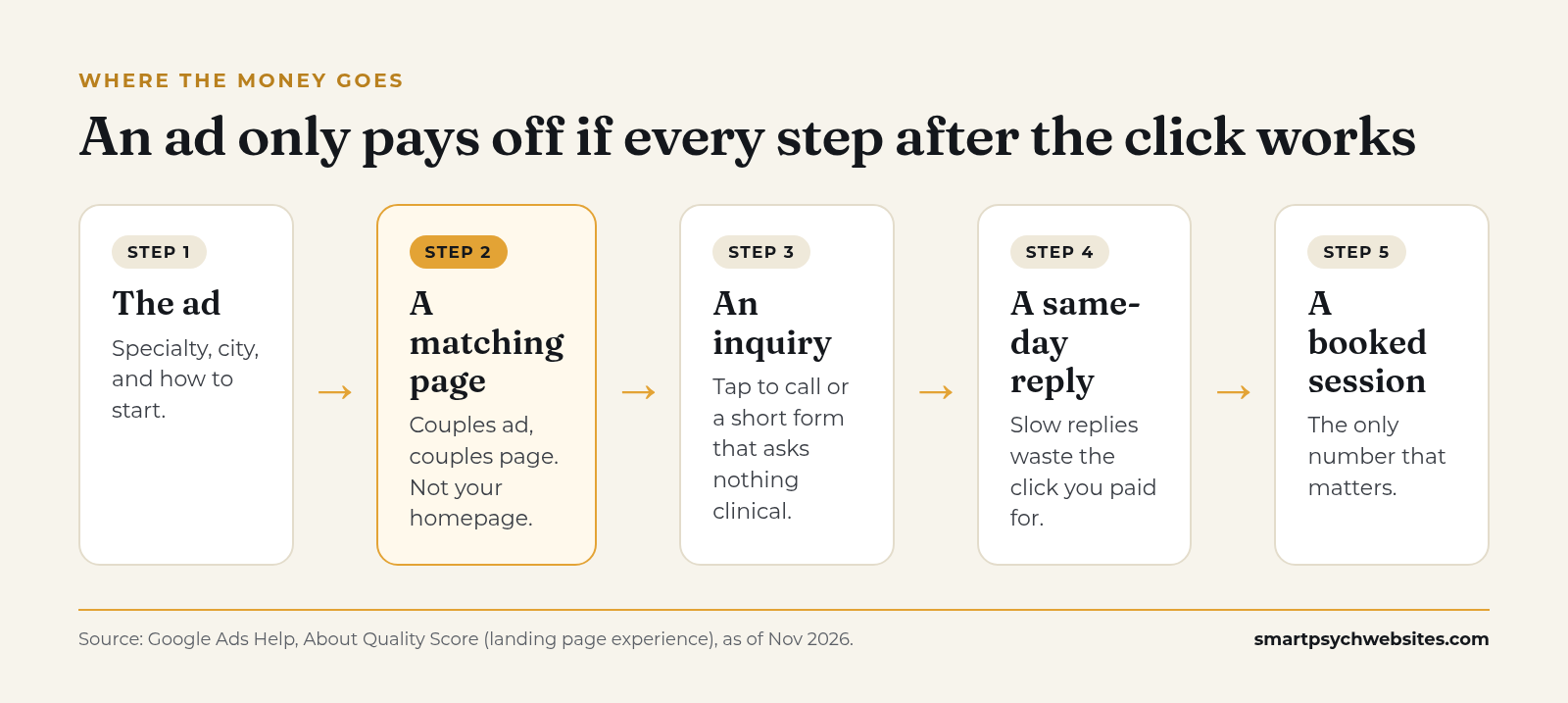 Clicks are not clients. Every step after the click is your website and your reply.
Step 1: Start with search ads only
Search campaigns show text ads to people actively searching. That is where intent is highest. Avoid broad display or automatic campaign types until search is working.
Step 2: Pick tight, local keywords
Choose terms that match what you offer and where. "Anxiety therapist [city]," "child therapist near me," "psychiatrist accepting new patients [city]." Use location targeting so you only show to people in your service area, plus states where you are licensed for telehealth.
Step 3: Add negative keywords from day one
Negative keywords stop your ads showing for searches you do not want (Google Ads Help: About negative keywords, as of Nov 2026). Common examples for therapists: "jobs," "salary," "degree," "school," "free," "training," "certification," "license." Check your search terms report weekly at first and keep adding.
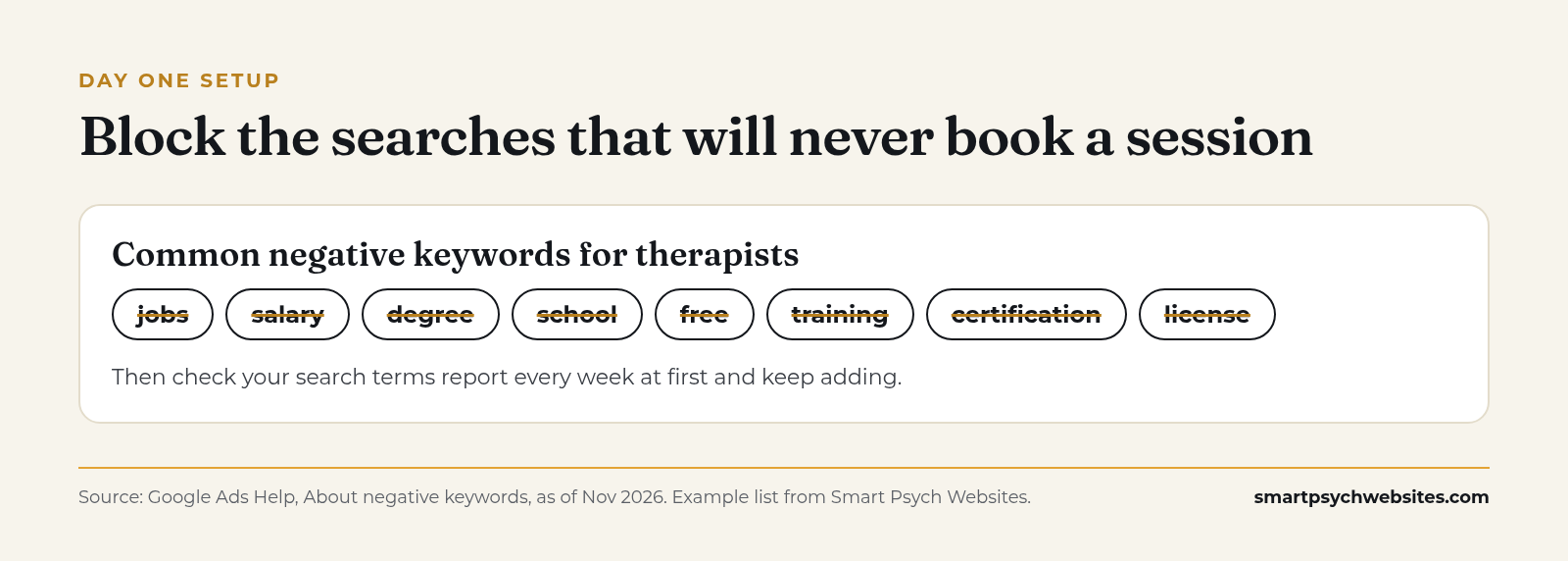 Starting list. Your search terms report will show you more.
Step 4: Send clicks to a matching page
An ad for "couples therapy in Austin" should land on your couples therapy page, not your homepage. The page should say what the ad said, show fees or insurance, and make contact easy on a phone.
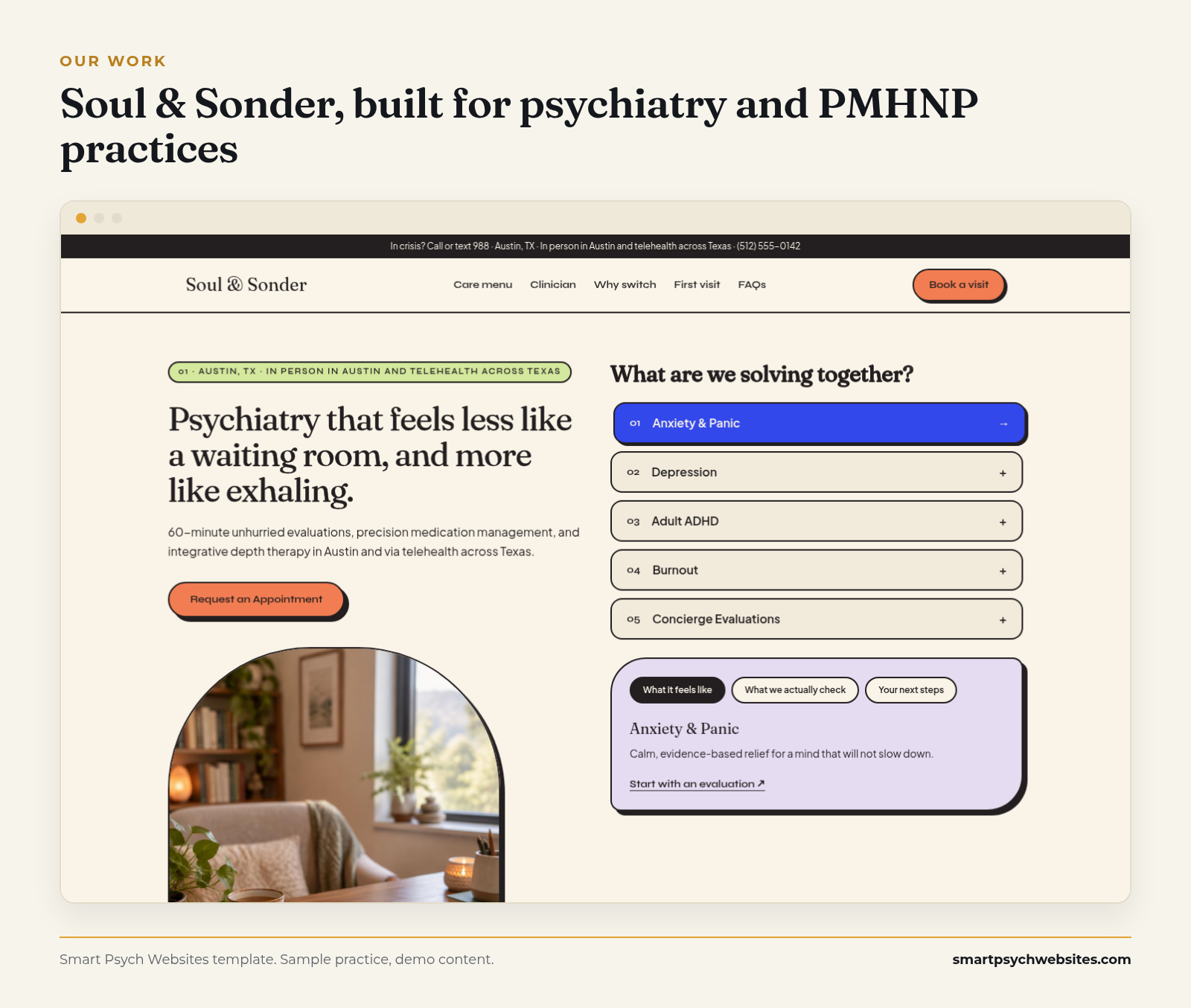 A specialty-first page that says what the ad said. Sample practice, demo content.
Every Smart Psych Websites site gives each specialty its own page, which is exactly what a good ad needs to land on. Plans start at $99 a month, the setup fee is waived when you sign up within 72 hours of viewing your free preview, and yearly plans never pay one, you own the site, content and domain from day one, and you launch in 5 days after onboarding. No call is needed to sign up.
See your free website preview. We build your practice on one of our mental health templates, with your details, free and with no call needed.
Step 5: Make it easy to call
Call assets add your phone number to the ad. For many people seeking therapy, a call or a short form is the next step. Have a plan for answering or returning calls the same day.
Step 6: Measure the result you care about
Clicks are not clients. Track inquiries, consults and first sessions from ads each month, then compare with spend. Google explains conversion measurement options (Google Ads Help: About conversion measurement), but see the privacy note above before you add tracking to sensitive pages.
Step 7: Write ads that sound like you
Ad text has tight limits, so lead with what matters most to someone searching: the specialty, the location, whether you take their insurance or offer telehealth, and how soon you have openings. Avoid language that promises outcomes or sounds clinical in a way that might unsettle people. "Anxiety therapy in Denver. In person or online. New clients welcome" is clear and calm. Check that your ad copy follows Google's editorial and healthcare policies before it runs.
Budget: what to expect
Cost per click varies widely by city, specialty and competition, and changes over time, so we will not quote a number. Google's Keyword Planner gives estimated bid ranges for your terms and location for free. Use it before deciding a budget.
A useful way to think about it: estimate what a new client is worth to your practice over a typical course of care, then decide what you are willing to spend to get one. Run ads for at least a month or two before judging, while watching the search terms report weekly.
Ads vs SEO: which comes first?
Ads and SEO answer the same searches in different ways.
| Google Ads | SEO and local SEO | |
|---|---|---|
| Speed | Can bring inquiries within days | Usually builds over months |
| Cost | Pay for every click | Pay in time or a monthly service, not per click |
| When you stop | Inquiries from ads stop | Rankings and content keep working |
| Restrictions | Health ad policies apply | Content and Google Business Profile guidelines apply |
How the two compare in general. Results vary by market.
Many practices do best with both: ads for short-term needs, SEO for the long run. If you can only do one and do not need clients this month, organic search and your Google Business Profile usually give more lasting value. See Google Business Profile for Therapists and Marketing Your Private Practice.
Where Smart Psych Websites fits
We build websites for mental health practices and focus on getting them found organically. For some practices, we also run Google Ads, on a case-by-case basis after a consultation to see whether ads fit your goals and market. If paid search makes sense for your practice, we'll talk it through on an optional strategy call. Either way, the website matters: a clear, fast site with dedicated specialty pages makes better landing pages for ads, and it builds the organic visibility that keeps working when you pause ads.
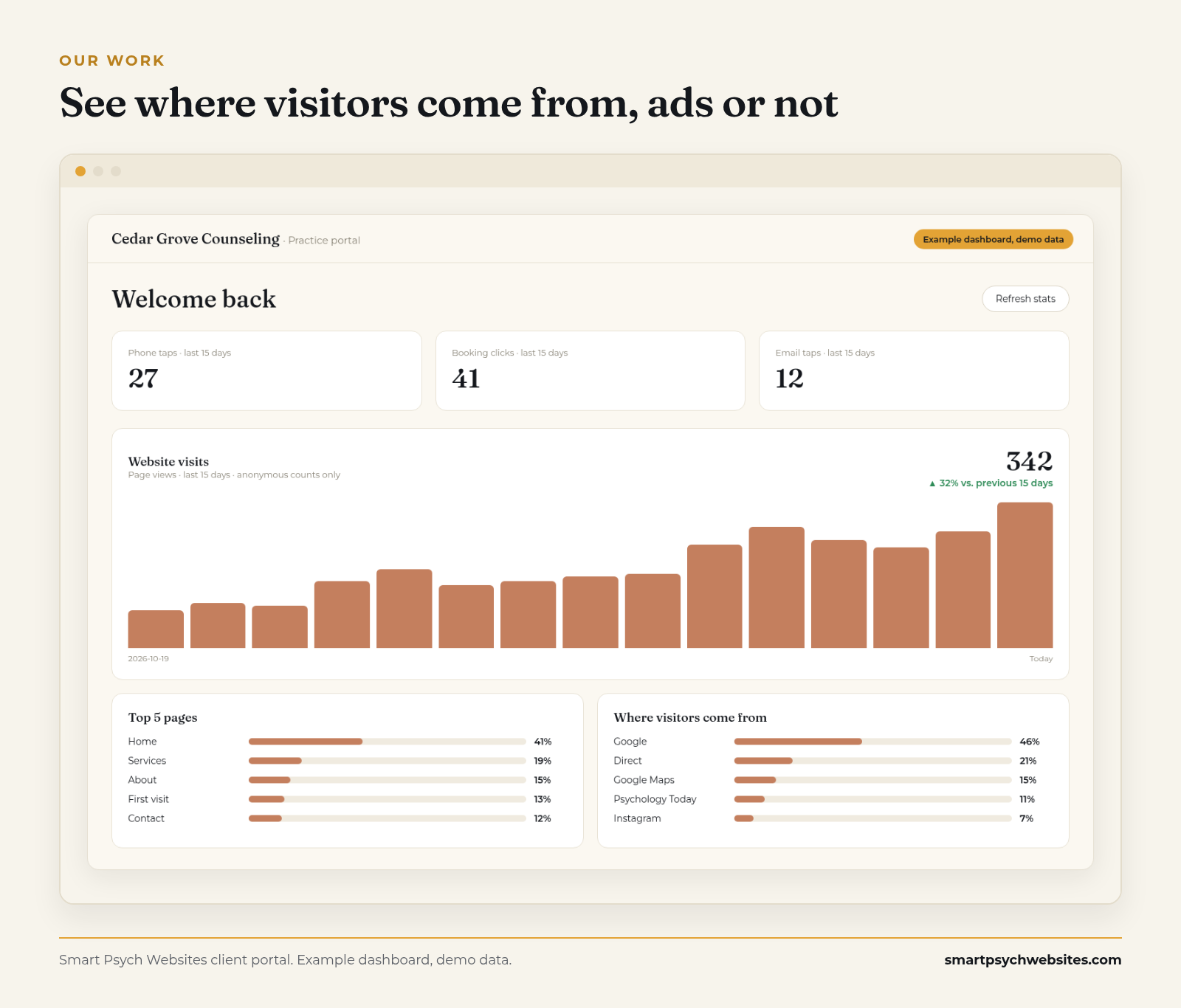 Your portal shows visits, calls and booking clicks, and where visitors come from. Example dashboard, demo data.
Why practices choose Smart Psych Websites
- Starts at $99 a month, with the setup fee waived when you sign up within 72 hours of viewing your free preview (never charged on yearly plans).
- Yours from day one: you own the site, content and domain.
- Live in 5 days after onboarding, with no call needed to sign up.
- Built for SEO and structured to show up in Google and answer engines, so you are not paying for every visitor.
- Organic Growth ($249 a month) adds four SEO articles a month aimed at the searches your future clients make. Local Domination ($499 a month) adds Google Business Profile management plus review collection and responses, for practices competing hard in local search.
- Our Organic Growth and Local Domination plans can include a 90-day growth guarantee, offered case by case to eligible practices. If we miss the agreed target, your next month is free.*
- Hosting, traffic reports and a client portal included, with edits made within 48 hours.
Browse templates or compare pricing.
*Eligibility is confirmed on a quick call. The target is at least 5 organic website inquiries or 500 visitors a month, measured over your first 90 days on the plan.
Honest limits: what we will and will not promise
- We do not publish ad results or ad pricing. Costs and results depend on your city, specialty and competition.
- Ads are not part of our standard plans. They are offered case by case after a consultation.
- The growth guarantee covers organic results on Organic Growth and Local Domination, not paid ads.
- We cannot get around Google's health ad policies, and nobody else can either. If a service needs certification, you need it first.
- Cancel anytime: give 15 days' notice and we export your full site code and content. The 90-day window only matters if you want to redeem the growth guarantee; leaving earlier just means the guarantee does not apply.
Get found without paying per click
The 2027 Get Found Checklist walks you through Google Business Profile, local SEO and website basics that help you show up without ad spend. Comment FOUND on our latest post on Instagram and we will send it, or get the free checklist here.
Want a site that works as an ad landing page and ranks on its own?
See your free website preview. We build your practice on one of our mental health templates, with your details, free and with no call needed.
Plans start at $99 a month. The setup fee is waived when you sign up within 72 hours of viewing your preview (or within 24 hours after a booked call, whichever ends later), and yearly plans never pay a setup fee.