Ethics code wording and Google and HHS pages were checked as of November 2, 2026 and can change.
A physician hands a patient your name. A friend mentions you over coffee. Either way, the next thing most people do is search for you. What they find in that moment, including your Google reviews or the lack of them, shapes whether they call.
For most businesses, the advice is simple: ask every happy customer for a review. Therapists cannot follow that advice. Your ethics code limits who you can ask, confidentiality limits how you can reply, and HIPAA applies to what you say in public. This guide explains what the codes and Google actually say, then lays out the ways to build trust on Google that stay inside those lines.
This is general information, not legal or ethics advice. Your licensing board and professional association have the final word for your practice.
Key takeaways
Key takeaways
- Do not ask therapy clients for reviews. The APA, ACA and NASW codes all bar soliciting testimonials from current clients, and the ACA code adds former clients.
- Never offer anything for a review. Google treats incentives as fake content and strictly prohibits them.
- Never confirm someone is a client in a reply. HHS has penalized providers for disclosing patient information in review replies.
- Let your website do the trust work. A clear photo, specialties, fees and first-session details answer the questions people look for in reviews. Smart Psych Websites builds that site from $99 a month, with the setup fee waived when you sign up within 72 hours of viewing your free preview (never charged on yearly plans).
What the ethics codes say about asking for reviews
Online reviews are a form of testimonial, and the major codes address testimonials directly. Read the exact wording of your own code, because the details differ.
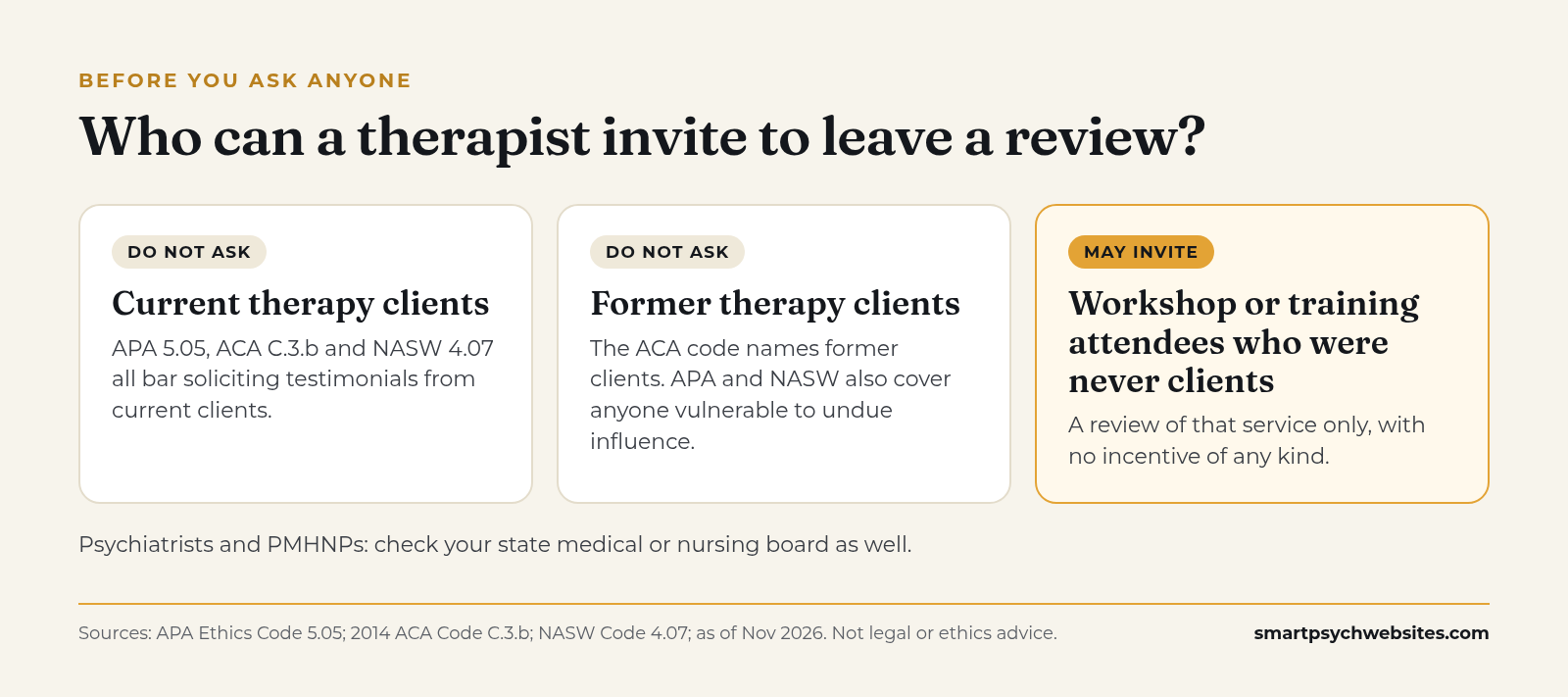 When in doubt, do not ask. Your code and board have the final word.
| Code | Who you may not solicit testimonials from | Source |
|---|---|---|
| APA (psychologists), Standard 5.05 | Current therapy clients, and others vulnerable to undue influence | APA Ethics Code |
| ACA (counselors), C.3.b | Current clients, former clients, and others vulnerable to undue influence | 2014 ACA Code, PDF |
| NASW (social workers), 4.07 | Current clients, and others vulnerable to undue influence | NASW Code of Ethics |
| Psychiatrists, PMHNPs, other licenses | Check your state medical or nursing board and association | Your board |
Summaries of each code's wording, checked November 2, 2026.
Psychologists: APA Ethical Principles, Standard 5.05
The APA code says psychologists do not solicit testimonials from current therapy clients or from other people who, because of their particular circumstances, are vulnerable to undue influence (APA Ethical Principles of Psychologists and Code of Conduct).
Counselors: ACA Code of Ethics, C.3.b
The ACA code goes further. Counselors who use testimonials do not solicit them from current clients, former clients, or any other persons who may be vulnerable to undue influence (2014 ACA Code of Ethics, PDF).
Social workers: NASW Code of Ethics, 4.07
The NASW code says social workers should not solicit testimonial endorsements from current clients or from other people who, because of their circumstances, are vulnerable to undue influence (NASW Code of Ethics).
Psychiatrists, PMHNPs and other licenses
Medical and nursing boards, and state law, may have their own rules on advertising and testimonials. If you prescribe, check your state medical or nursing board and your professional association before you build any review process.
The practical takeaway: directly asking current clients for Google reviews is off the table under all three codes above, and counselors should not ask former clients either. That rules out the review request emails, front desk cards and follow-up texts other businesses use.
What Google allows and prohibits
Google's own rules sit on top of your ethics code. Google says reviews must reflect a genuine experience, and that offering incentives such as free or discounted services in exchange for posting, changing or removing reviews is strictly prohibited (Google Business Profile Help: Tips to get more reviews, as of Nov 2026).
That means no gift cards, no discounted sessions and no favors in exchange for reviews. It also means reviews from colleagues or friends who have never used your services do not belong on your profile, however kind they are.
Google does let any business create a review link or QR code. Whether you can share it with clients is a question for your ethics code, not Google.
How to earn more Google reviews ethically, step by step
You cannot ask, but you can make it easy for people who want to say something to find the right place, and you can give them a reason to choose you without a review at all.
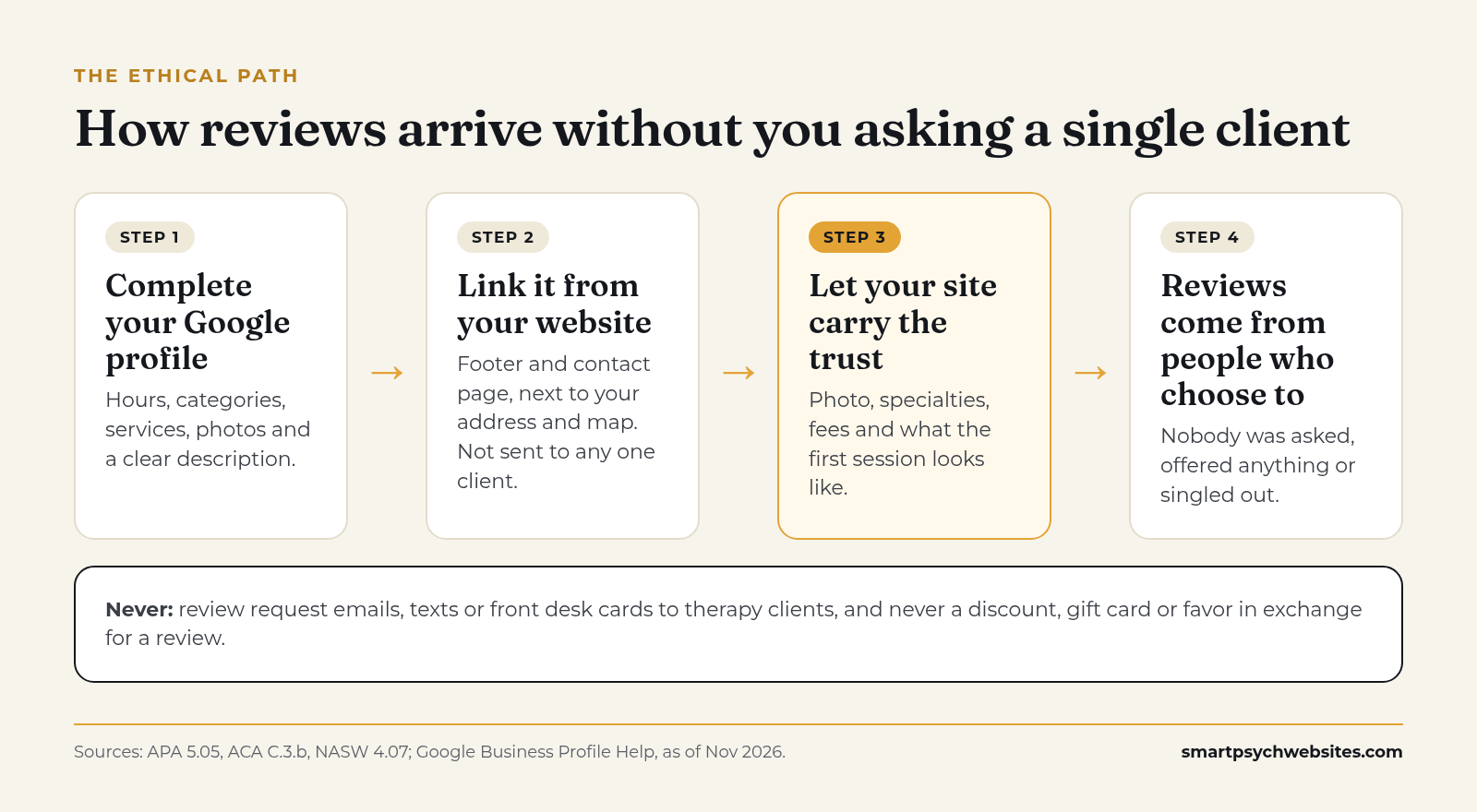 No emails, texts or cards to clients, and nothing offered in exchange.
Step 1: Complete your Google Business Profile
A full profile with accurate hours, categories, services, photos and a clear description does more for a first impression than a handful of stars. If yours is thin, start with Google Business Profile for Therapists: Setup Checklist.
Step 2: Make the profile easy to find, without asking
Linking to your Google profile from your website footer or contact page, alongside your address and map, is a normal way to help people get directions. Some clinicians see this as different from soliciting reviews, because it is not directed at any individual client. Others prefer to leave it out. Check your code and, if in doubt, your association's ethics consultation service.
Step 3: Let your website carry the trust
Most of the work reviews do for a plumber, your website can do for you. A clear photo, plain-language credentials, the specific problems you treat, your approach, your fees and what the first session looks like answer the questions people would otherwise look for in reviews. We cover those pages in Therapist Website Design.
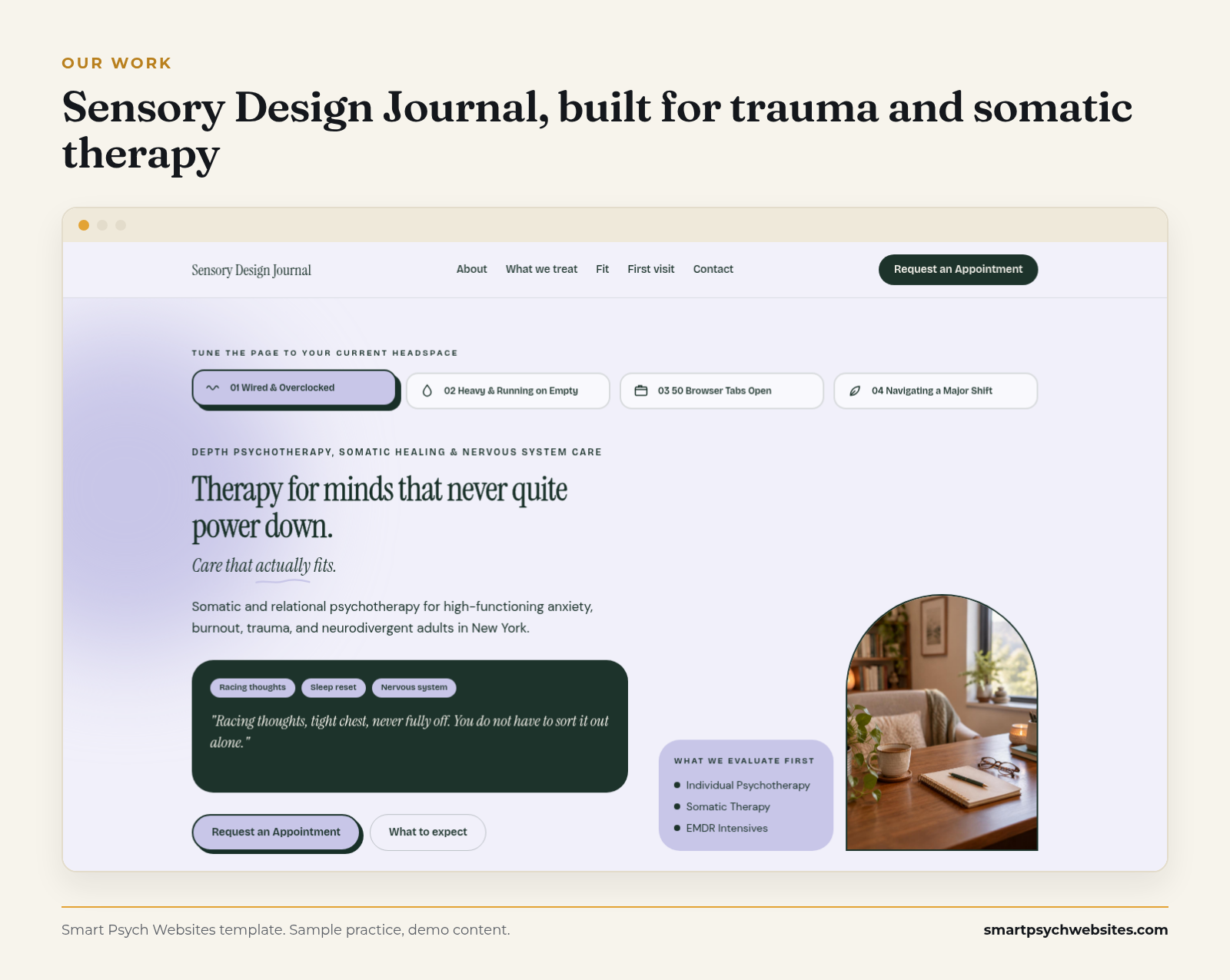 One of our newest templates. A first screen that answers "can this person help me?" Sample practice, demo content.
This is exactly what we build at Smart Psych Websites. Plans start at $99 a month, the setup fee is waived when you sign up within 72 hours of viewing your free preview, and yearly plans never pay one, you own the site, content and domain from day one, and you launch in 5 days after onboarding. Every site is built for SEO and structured to show up in Google and answer engines. There is no call needed to sign up. Browse our templates or see pricing.
See your free website preview. We build your practice on one of our mental health templates, with your details, free and with no call needed.
Step 4: Earn reviews from services that are not therapy
If you run workshops, trainings, consultation groups for clinicians, or speaking events, those participants are customers of a different service and are not your therapy clients. Reviews about those experiences are genuine. Just make sure the person was never a therapy client, keep the request to that service, and offer nothing in return.
Step 5: Show professional endorsements in the right places
Directory memberships, board certifications and professional association listings can sit on your website. Peer endorsements from colleagues are fine on your own site as long as they are honest and the colleague is not presented as a client. They do not belong on Google as reviews.
Step 6: Keep doing the work that brings referrals
Physicians, schools and other clinicians who refer to you send the people who then search for you. Strong referral relationships plus a complete profile and a clear website can bring steady inquiries without a big review count. More in How to Get More Therapy Clients.
How to reply to Google reviews as a therapist
This is where the most serious mistakes happen. A reply that confirms someone was your client discloses protected health information, even if the reviewer already said so themselves.
HHS has taken enforcement action on exactly this. In 2022, the Office for Civil Rights announced a $23,000 settlement with a dental practice that disclosed patient names, treatment and insurance details in replies to online reviews, and said providers cannot disclose patient information when responding to negative reviews (HHS announcement). OCR also imposed a $50,000 civil money penalty on another dental practice that disclosed a patient's information responding to a negative review (HHS enforcement summary). Those were dental practices, but the same rules apply to mental health providers covered by HIPAA, and the information is more sensitive.
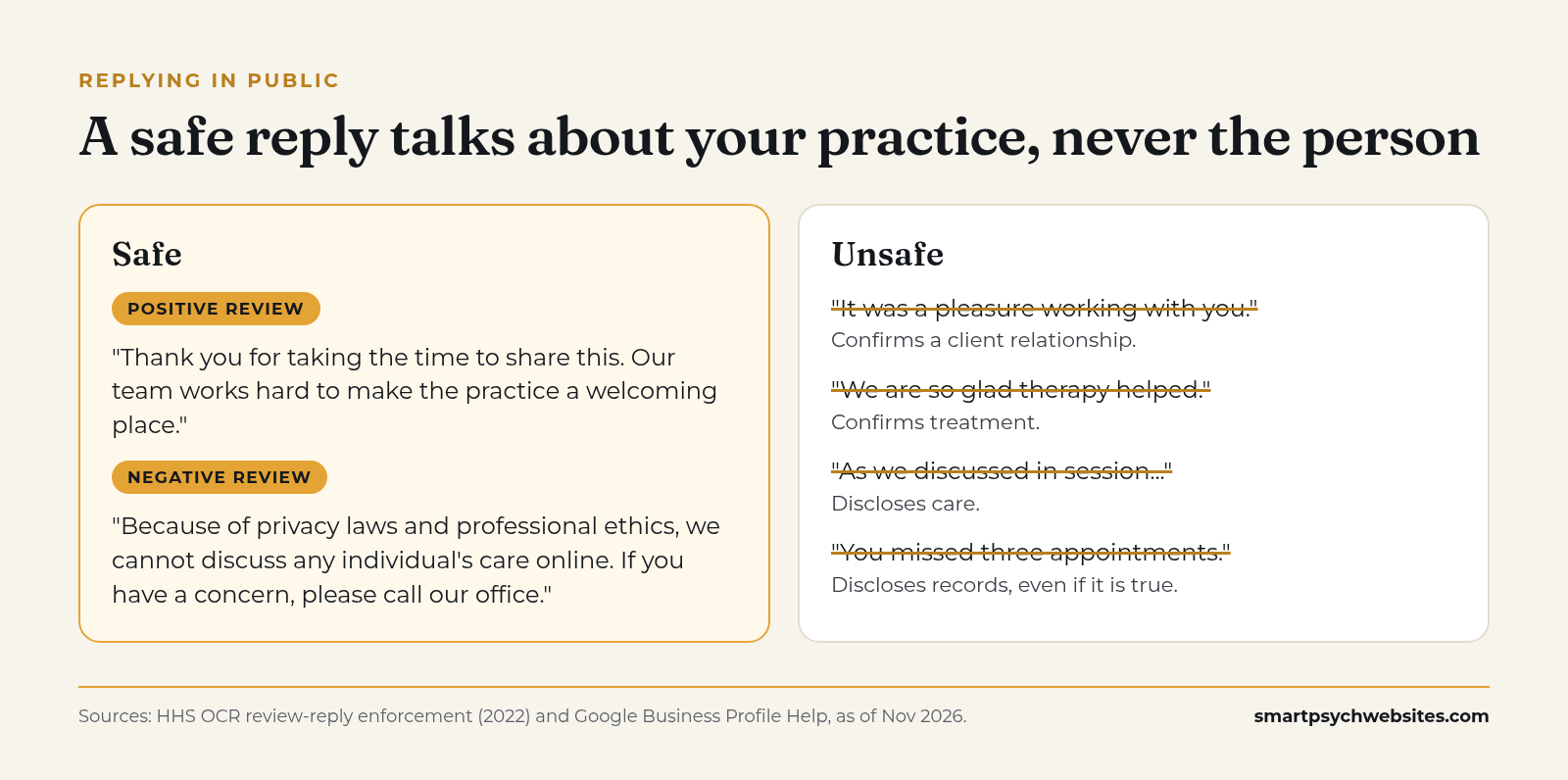 Read every reply out loud and ask: does this tell a stranger this person is my client?
Do's and don'ts for every reply
| Do | Don't | |
|---|---|---|
| Relationship | Talk about the practice and its values | Confirm or deny the reviewer is or was a client |
| Details | Keep it short and general | Mention a session, diagnosis, treatment, appointment, fee or anything they told you |
| Names | Sign off with the practice name | Use the reviewer's name in a way that implies a relationship |
| Negative reviews | Use a standard privacy reply and invite a call to the office | Correct facts, argue or explain what happened |
| Rule-breaking reviews | Report it through your Business Profile | Ask friends to bury it with positive reviews |
| Unsure | Do not reply. Silence is always safe | Reply in a hurry |
Based on HHS enforcement and Google Business Profile Help, checked November 2, 2026.
Replying to a positive review
Thank the person for the kind words about the practice, without accepting them as a client.
"Thank you for taking the time to share this. Our team works hard to make the practice a welcoming place, and we appreciate the kind words."
Notice what that reply does not say: "It was a pleasure working with you," "We're glad therapy helped," or "See you next week." Each of those confirms a relationship.
Replying to a negative review
Respond with your general policy and an offer to talk privately, and nothing more.
"We take all feedback seriously. Because of privacy laws and professional ethics, we cannot discuss any individual's care online. If you would like to talk about a concern, please call our office directly."
Do not correct facts in public, even if the review is unfair. If a review violates Google's policies, such as being posted by someone who was never at your practice or containing hate speech, you can report it through your Business Profile (Google Business Profile Help: Manage customer reviews).
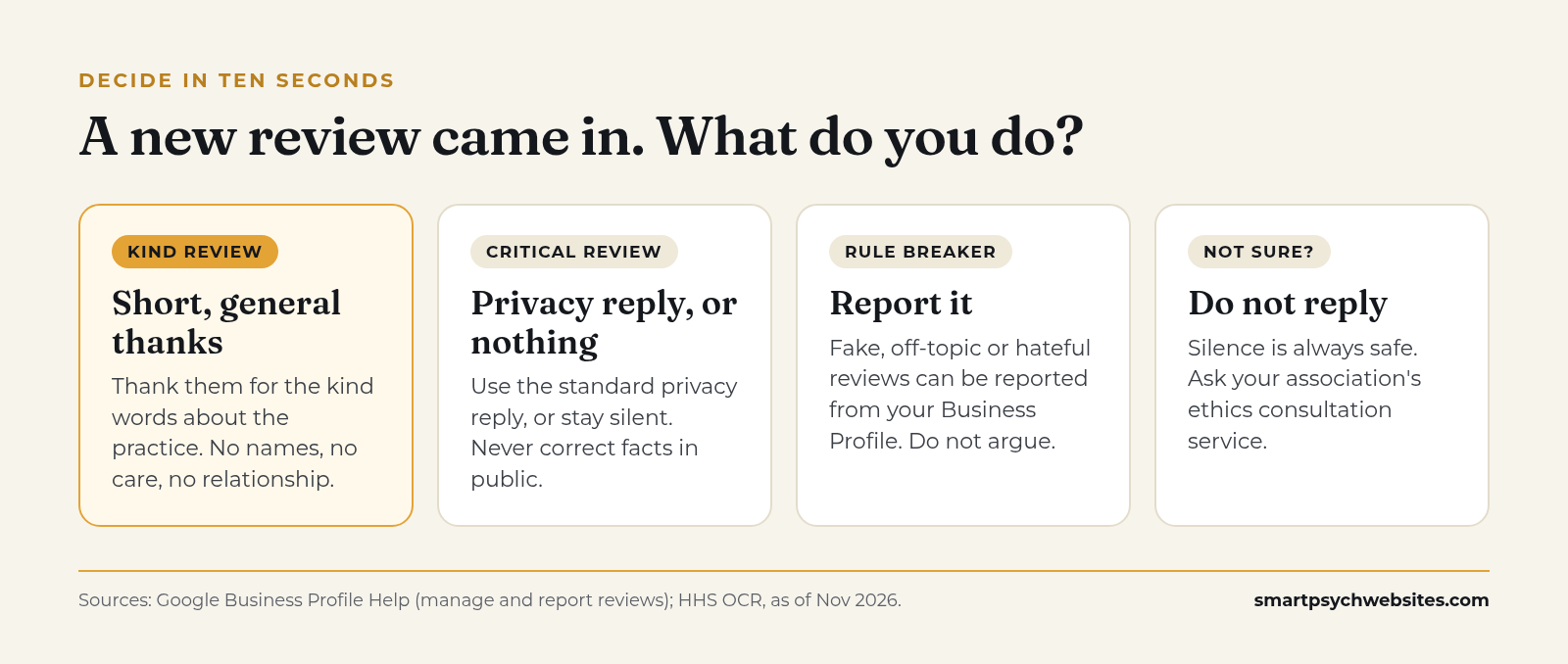 Four cases cover nearly every review you will see.
What about reviews on other sites?
The same principles apply on Yelp, Healthgrades, Psychology Today and anywhere else. Your ethics code governs whether you can ask. HIPAA governs what you can say in a reply. If a platform lets you turn off reviews or hide ratings, that can be a reasonable choice for a therapy practice, and it says nothing bad about your work.
A simple reviews policy for your practice
Group practices in particular benefit from writing this down so every clinician and admin handles it the same way. Your policy might say:
- We do not ask therapy clients for reviews or testimonials.
- We do not offer anything in exchange for reviews.
- Only the practice owner or a named person replies to reviews, using our approved templates.
- Replies never confirm someone is a client or mention care.
- Negative reviews get the standard privacy reply, or no reply.
- Reviews that break Google's rules are reported, never argued with.
Share it with new hires along with your social media policy.
How reviews fit into getting found
Reviews are one of many signals Google weighs for local results. Google's guidance on local ranking lists relevance, distance and prominence, and says review count and rating factor into prominence (Tips to improve your local ranking, as of Nov 2026). That is one factor, not the whole picture. A complete profile, a website with a page for each specialty, and consistent details across directories all count too. For the full picture, read Local SEO for Therapists and SEO for Mental Health Professionals.
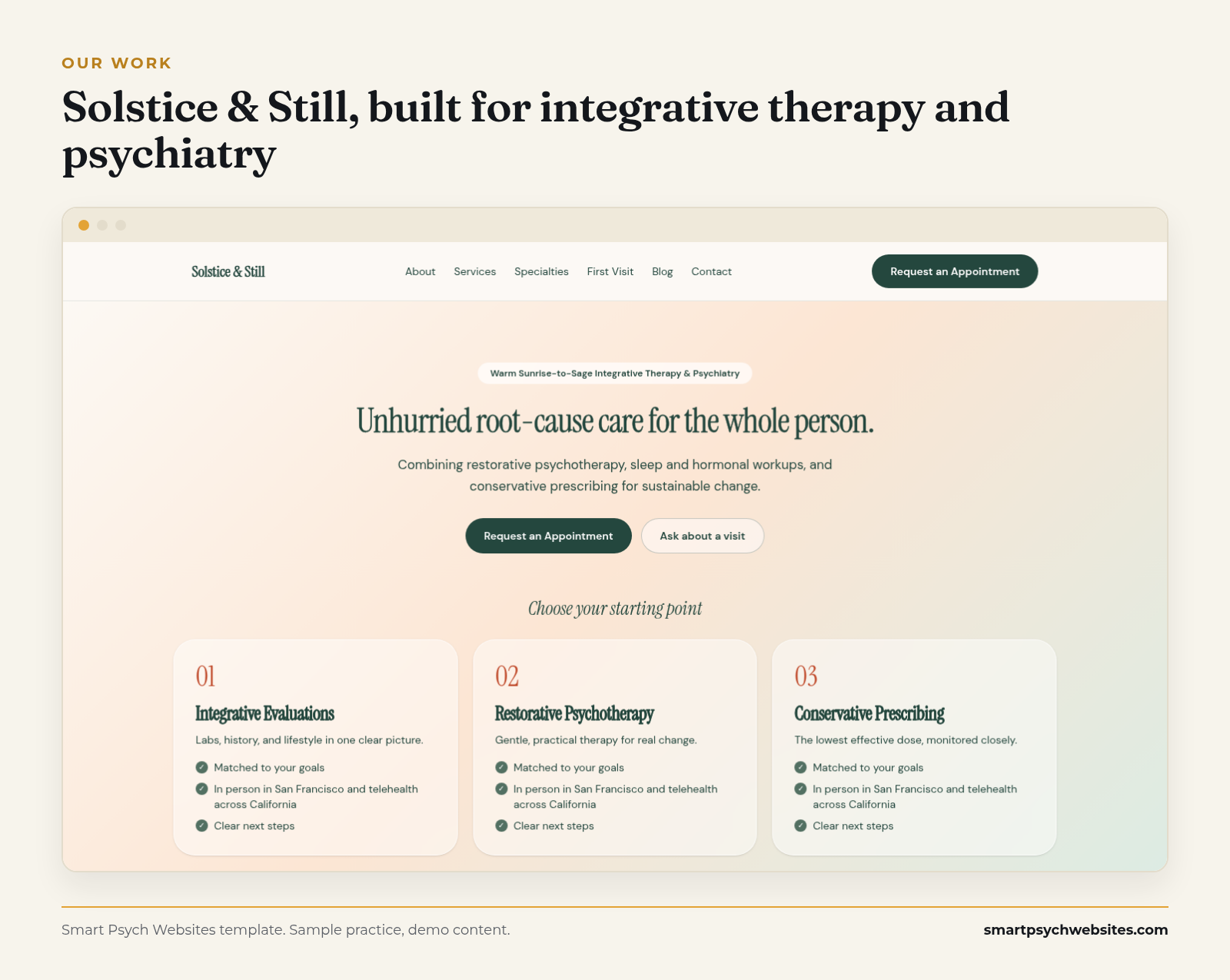 A page for each specialty gives Google, and people, a clear reason to choose you. Sample practice, demo content.
Where Smart Psych Websites fits
If you would rather hand the getting-found part off, that is what we do:
- Starts at $99 a month, with the setup fee waived when you sign up within 72 hours of viewing your free preview (never charged on yearly plans).
- Yours from day one: you own the site, content and domain.
- Live in 5 days after onboarding, with no sales call needed to sign up.
- Built for SEO and structured to show up in Google and answer engines.
- Organic Growth ($249 a month) adds four SEO articles a month. Local Domination ($499 a month) adds Google Business Profile management plus review collection and responses, kept inside your ethics code.
- Our Organic Growth and Local Domination plans can include a 90-day growth guarantee, offered case by case to eligible practices. If we miss the agreed target, your next month is free.*
- Edits within 48 hours: 10 small edits or 2 new pages a month on the $99 and $249 plans, and 20 or 4 on $499.
*Eligibility is confirmed on a quick call. The target is at least 5 organic website inquiries or 500 visitors a month, measured over your first 90 days on the plan. See pricing for plan terms.
Honest limits: what reviews can and cannot do
- We never ask your therapy clients for reviews. Review collection on Local Domination only reaches people your code allows you to ask, such as colleagues, referral partners or workshop attendees who were never clients. Our replies stay general and never confirm that someone is a client.
- Your Google rating is not fully in your control. Google decides which reviews stay up and how profiles rank. Nobody can promise a star count.
- A low review count is normal for therapists. It reflects the rules you work under, not the quality of your care. A clear website and complete profile do more for you than chasing stars.
- Some practices are better off with reviews turned off on platforms that allow it.
Get the checklist and your free website preview
The 2027 Get Found Checklist puts your Google profile, your Psychology Today profile and your search basics on one page, with a scorecard so you know where you stand. Comment FOUND on our latest post on Instagram and we will send it to you, or get the free checklist here.
Want people who find you on Google to land on a site that turns searches into calls?
See your free website preview. We build your practice on one of our mental health templates, with your details, free and with no call needed.
Plans start at $99 a month. The setup fee is waived when you sign up within 72 hours of viewing your preview (or within 24 hours after a booked call, whichever ends later), and yearly plans never pay a setup fee.