Key takeaways
- Ranking is step one. A booked session is the goal, so your pages have to turn a search into a call.
- Pages that match how clients search, a fast phone-friendly site and an active Google profile move rankings most.
- Track three layers: search visibility, actions on Google and real inquiries.
- Smart Psych Websites builds this in from day one, starting at $99 a month. Get a free preview of what your practice website could look like, built with your details, free and with no call needed.
You open Google Search Console on a Sunday night and see that your practice showed up in search a lot last month. Then you look at your calendar and the Tuesday 2pm slot is still empty. Search visibility and booked sessions are two different numbers, and good SEO for mental health professionals moves both.
This guide covers where therapy and psychiatry practices actually appear in Google, the handful of things that move those rankings, what to skip, and how to tell whether search is bringing you calls. It is written for solo therapists, psychiatrists, PMHNPs and group practices who would rather spend their week with clients than on marketing.
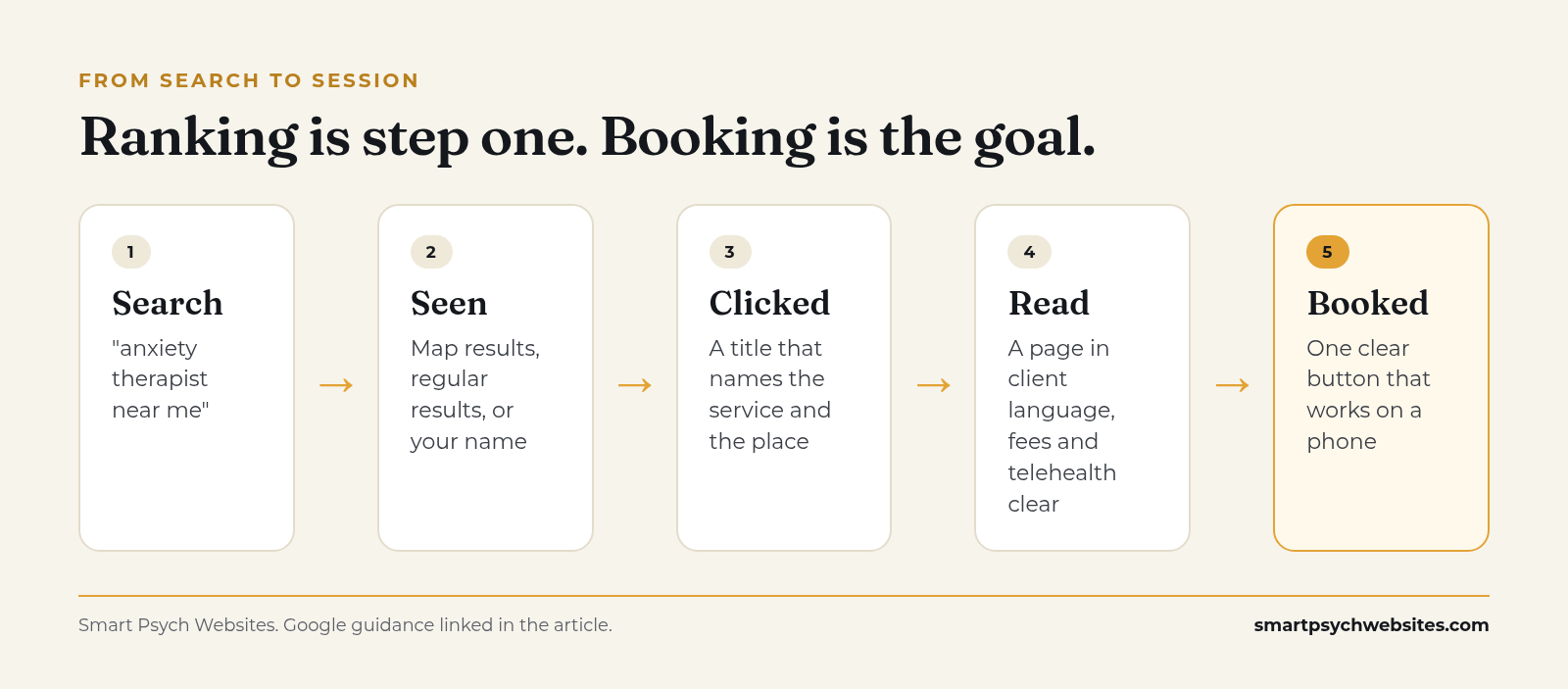 How a search turns into a booked session. Source: Smart Psych Websites.
Where mental health practices show up in Google
When someone looks for help, they rarely search for your name. They type something like "anxiety therapist near me," "psychiatrist accepting new patients" or "couples counseling Pasadena." Google answers that kind of search in a few places, and each one runs on different signals.
The map results
For local searches, Google usually shows a map with a short list of practices at the top. Google says these local results are based mainly on relevance, distance and prominence (Google Business Profile Help). You cannot move your office closer to the searcher, so the work goes into relevance (a complete, accurate profile) and prominence (how well known the practice is online, including links and reviews). We cover the quick map fixes in Local SEO for Therapists: 5 Fixes You Can Make This Week.
The regular results below the map
Under the map sit the standard results: directories, group practices, hospital systems and individual practice sites. This is where your website pages compete. A page about "EMDR therapy in Long Beach" can rank here for people who will never scroll the map.
Searches for your name
People who get your name from a physician, a friend or a directory will often search it before they reach out. They want to see that you are real, current and easy to contact. If your own site does not come up first for your name, fix that before anything else.
What moves rankings for a therapy or psychiatry practice
Google publishes its own guidance on how search works, and most of it is plain common sense applied consistently (Google SEO Starter Guide). For a mental health practice, these are the levers that matter most.
| SEO factor | Impact | What it means for you |
|---|---|---|
| Pages that match client searches | High | One page per specialty, in client words |
| Google Business Profile | High for local searches | Verified, complete, consistent details |
| Mobile speed and usability | Medium | Readable, tappable, quick to load |
| Titles and descriptions | Medium | Service plus place earns the click |
| Helpful articles | Builds over months | Answer the questions from consult calls |
| Links from local partners | Supporting | Referral partners and directories |
Impact levels are our working estimate, based on Google's SEO Starter Guide and how local results are ranked.
Pages that match how clients search
Clients search in their own words. They type "therapist for panic attacks," not "evidence-based treatment of panic disorder." Each service you want to be found for needs its own page, written in the words clients use, with your city or service area named naturally.
A good specialty page answers what a person wonders before booking:
- Who this is for, described the way a client would describe it
- What sessions look like and how long treatment often takes in your practice
- Whether you offer telehealth, in person or both
- Fees, insurance and superbills
- How to start, with one clear button
One general "Services" page with eight bullet points gives Google very little to rank. Eight focused pages give it eight chances.
A site Google can read and people can use on a phone
Google mainly uses the mobile version of a site for indexing and ranking (Google Search Central). If your phone version hides content, loads slowly or makes people pinch to read, that is the version being judged. Google also describes Core Web Vitals, which measure loading speed, responsiveness and visual stability, as part of page experience (Core Web Vitals).
The basics that matter here: fast pages, readable text, buttons big enough to tap, and a contact path that works on a phone. We go deeper on the design side in Therapist Website Design: What Turns Visitors Into Inquiries.
Proof you are a real, active local practice
Prominence comes from signals across the web as well as your own site. Useful ones for mental health practices:
- A complete Google Business Profile with accurate categories, hours and photos of your office
- The same practice name, address and phone number on your site, Google and directories such as Psychology Today
- Links from places that know you: referral partners, local professional associations, a university training program you supervise for, community organizations you present to
You do not need hundreds of links. A few genuine local ones carry more weight than a pile of paid directory listings.
Content that answers questions people ask before booking
Google's guidance asks for content that is written for people first and shows real experience and expertise (Creating helpful, reliable, people-first content). Mental health is a topic where readers and search engines both expect accuracy, so clinician authorship helps. Put the author's name and credentials on every article.
Good article topics come straight from your consult calls: "What does the first therapy session look like?", "Do I need a referral to see a psychiatrist?", "How is couples therapy different from individual therapy?" One useful article a month, kept up for a year, does more than a burst of ten in January.
Titles and descriptions that earn the click
Your page title and meta description are often the first thing a person reads in search results. Google explains how it builds title links and snippets from your page (title links, meta descriptions). Write a title that says the service and the place, such as "Anxiety Therapy in Pasadena | Practice Name," and a description that says who it is for and how to start.
What does not move rankings, or backfires
Some common advice wastes your time, and some of it can get a profile suspended.
- Keywords in your Google Business Profile name. Google's guidelines say your profile name should match your real-world business name, and adding extra words can lead to suspension (Guidelines for representing your business on Google).
- City names stuffed into every sentence. Name your area where it reads naturally. Lists of twenty suburbs at the bottom of a page read badly to people.
- Paid link packages. Links bought in bulk from unrelated sites carry risk and little value.
- Thin daily blog posts. A 300-word post that restates the topic in general terms gives no one a reason to read it.
- Chasing national terms. "Therapist" or "anxiety" on their own are dominated by large health publishers. Your wins are local and specific.
Impressions vs calls: how to tell if SEO is working
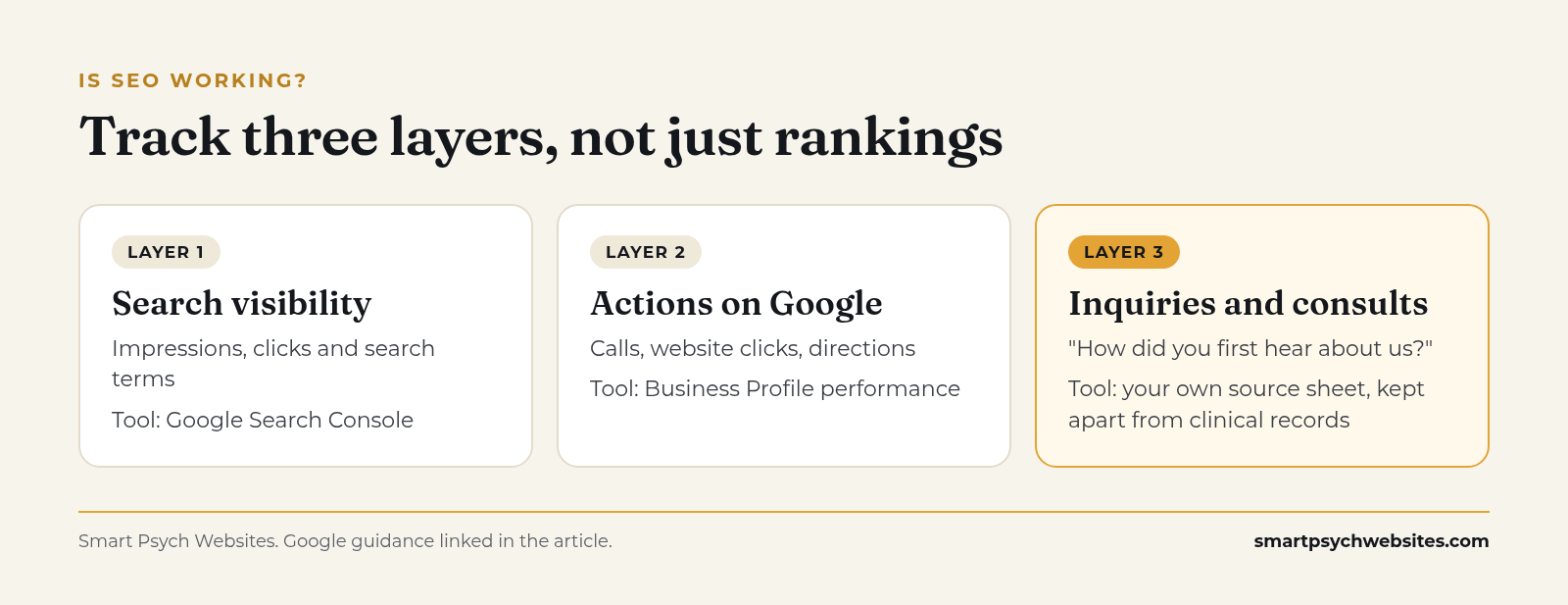 Three layers to track. Source: Smart Psych Websites.
Rankings are a means. The number you care about is how many of the right people reach out. Track three layers.
Layer 1: Search visibility
Google Search Console is free and shows how often your pages appeared in search (impressions), how often people clicked, and for which search terms (Google Search Console). Watch the search terms report. If you see "trauma therapist [your city]" climbing, the page is working.
Layer 2: Actions on Google
Your Google Business Profile shows calls, website clicks and direction requests from your listing. These are people who found you and took a step.
Layer 3: Inquiries and booked consults
This is the layer most practices skip. Add one question to your intake or consult call, "How did you first hear about us?", and record the answer in your own tracking sheet. Keep this separate from clinical records and keep it to the source only.
If impressions rise and calls do not, the problem usually sits on the page: the wording does not match what the person searched, fees are hidden, or the contact path is hard to use on a phone. That is a website and copy fix more than an SEO fix.
Privacy and ethics guardrails for mental health SEO
Mental health marketing carries rules that other industries do not have.
- No client stories or testimonials in your content. Many professional codes restrict soliciting testimonials. The APA Ethics Code, for example, bars psychologists from soliciting testimonials from current therapy clients (APA Ethics Code, Standard 5.05). Check your own license and board.
- Careful with tracking tools. Pixels and tracking scripts on pages where people request appointments can expose sensitive information. Keep clinical details out of website forms entirely and send people to your HIPAA-compliant intake or EHR for anything clinical.
- Review replies stay general. Never confirm that someone is or was a client when you respond to a review. HHS has settled with a psychiatric practice that disclosed patient information in responses to Google reviews (HHS OCR, Manasa Health Center).
A 90-day SEO plan for a busy clinician
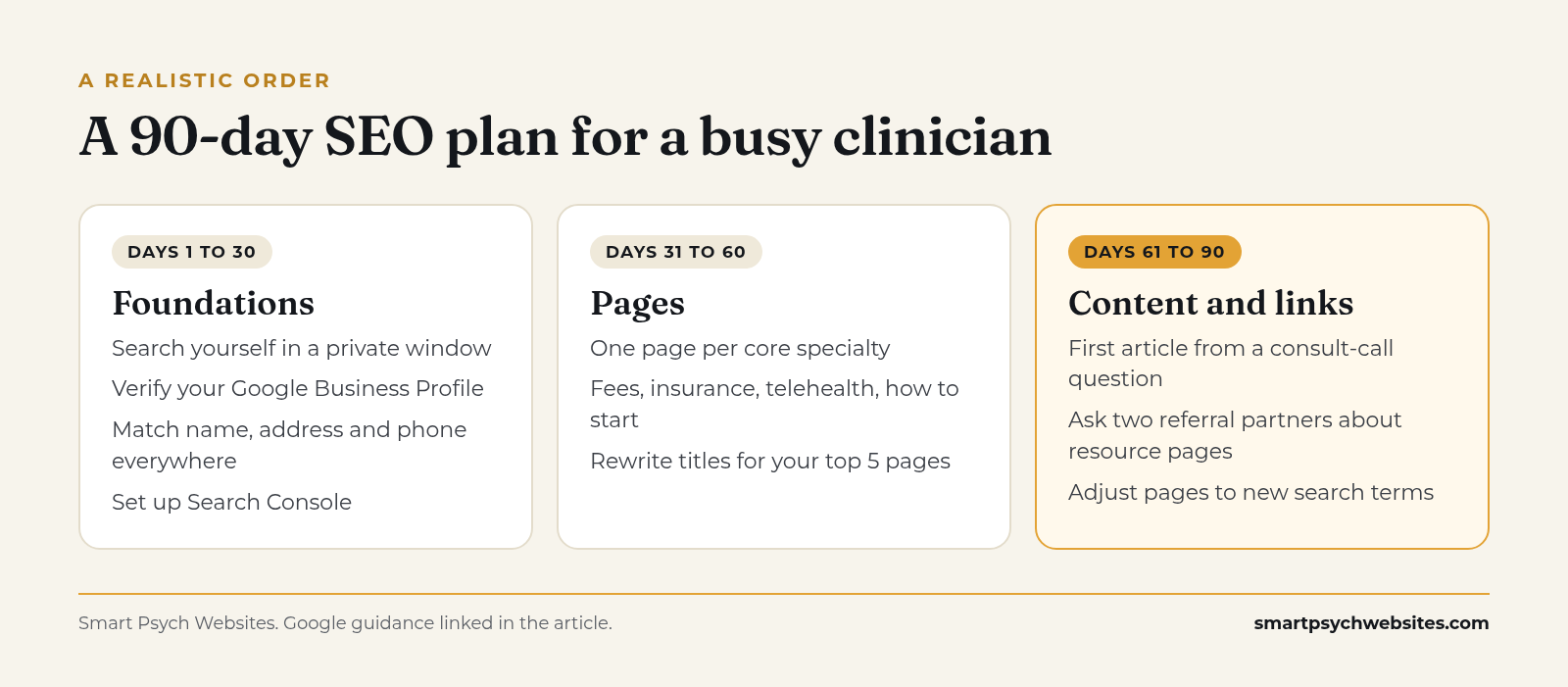 A 90-day plan at a glance. Source: Smart Psych Websites.
You do not need to do everything at once. Here is a realistic order.
Days 1 to 30: Foundations
- Search your name, your practice name and "[your specialty] [your city]" in a private browser window and note what shows up
- Complete and verify your Google Business Profile
- Make your name, address and phone match across your site, Google and directories
- Set up Google Search Console
Days 31 to 60: Pages
- Write one page per core specialty, in client language, with your area named
- Add fees, insurance, telehealth and "how to start" to each page
- Rewrite page titles and meta descriptions for your top five pages
Days 61 to 90: Content and links
- Publish your first article, answering a question you hear on every consult call
- Ask two referral partners whether they list local resources on their site
- Check Search Console for new search terms and adjust the matching page
If you are a psychiatrist or PMHNP, the same plan applies with a few prescriber-specific pages. We cover those in SEO for Psychiatrists: How Independent Practices Get Found. For the wider picture beyond search, see Digital Marketing for Mental Health Professionals and How to Get More Therapy Clients.
How Smart Psych Websites handles this for you
Most clinicians do not have time for all of this. That is why we build it into every site.
- Starts at $99 a month. See every plan on our pricing page.
- $0 setup fee when you claim your free website within 72 hours of completing onboarding.
- You own your site from day one, and we can launch it in 5 days.
- Built for SEO from day one, structured to show up in Google and in answer engines.
- Made only for mental health practices. Browse our templates.
Our Organic Growth and Local Domination plans come with a 90-day growth guarantee for eligible practices. If we miss the target, your next month is free.*
*Eligibility is confirmed on a quick call. The target is at least 5 organic website inquiries or 500 visitors a month, measured over your first 90 days on the plan.
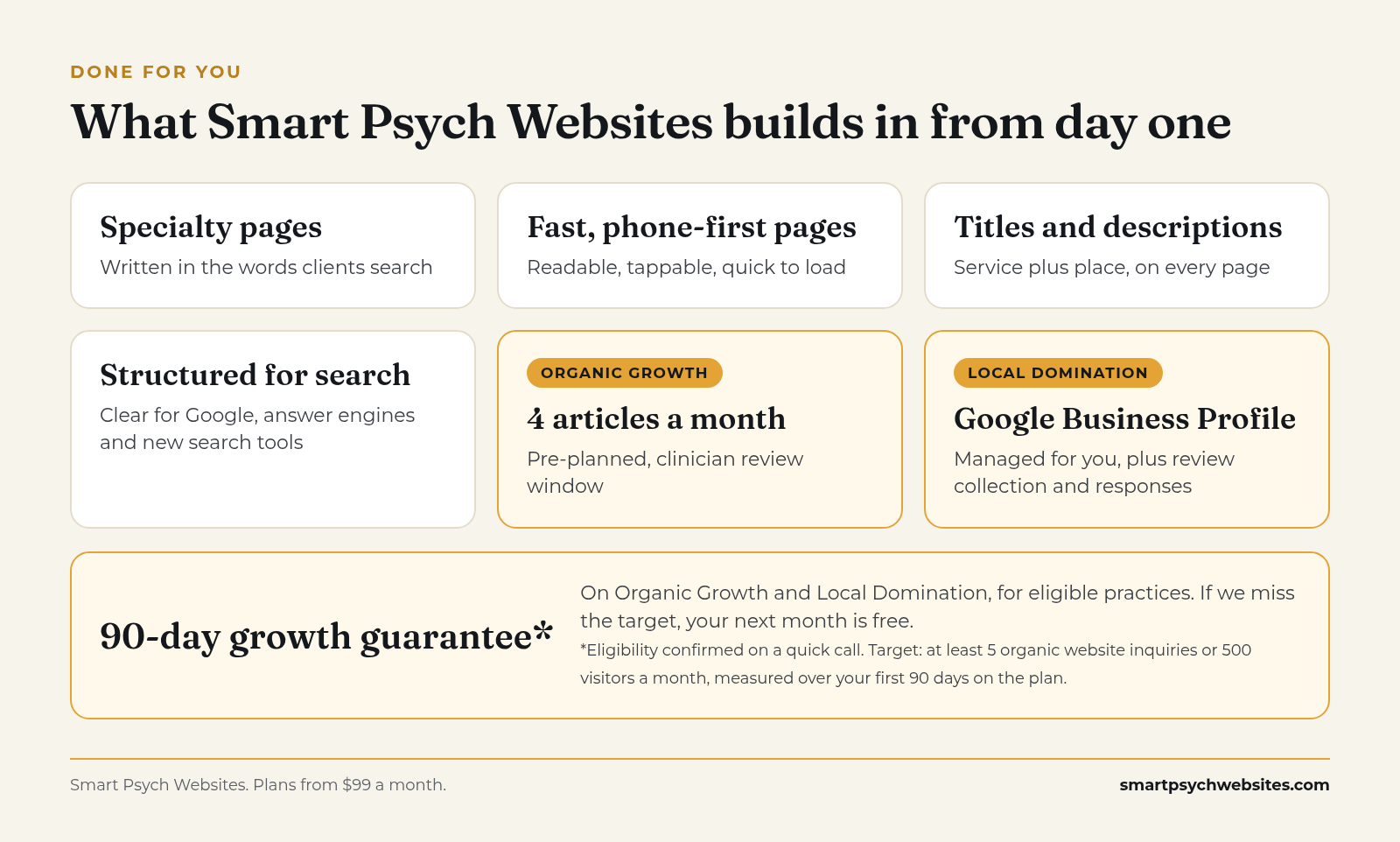 What we build in from day one. Source: Smart Psych Websites.
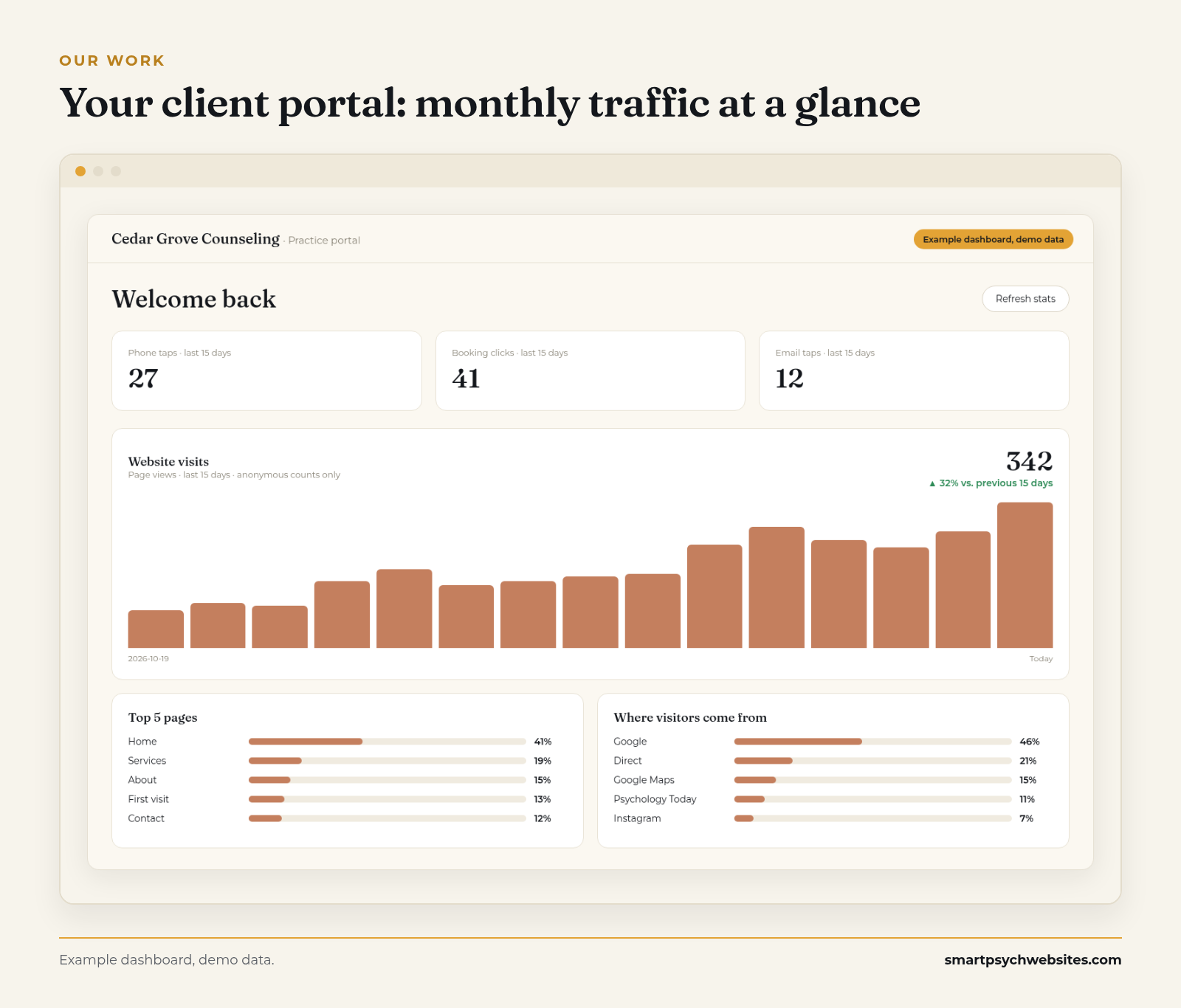 Example dashboard, demo data. Every plan includes the client portal and a monthly traffic report.
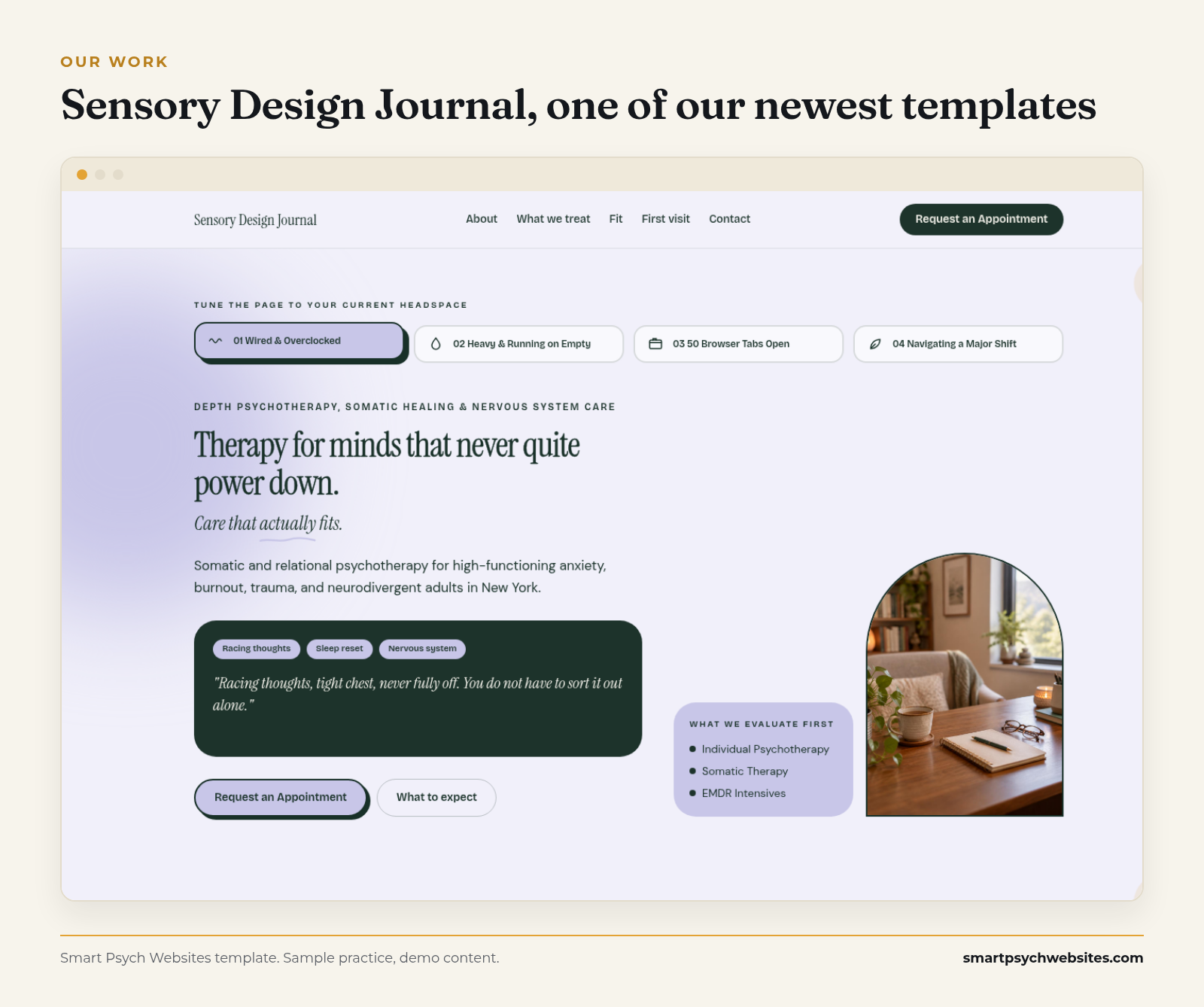 Sensory Design Journal, one of our newest templates. Demo content.
When to do this yourself
If you have one location, a few hours a month and enjoy writing, the 90-day plan above is very doable on your own. Bring us in when you would rather spend that time with clients.
Get the checklist, or let us look for you
Want the whole list in one place? The 2027 Get Found Checklist covers your Google profile, a Psychology Today profile rewrite, website search basics, and a 2027 mental health awareness calendar. Comment FOUND on our latest post on Instagram and we will send it to you, or get the free checklist here.
Want to see where your own site could go? Get a free preview of what your practice website could look like. We build it with your details, free and with no call needed.
No website yet? We will show you your practice on one of our mental health templates, with your details, before you pay anything: see your free website preview.
On our Organic Growth plan, we write four SEO articles a month for your site, so this work keeps happening while you see clients. Compare plans on our pricing page.